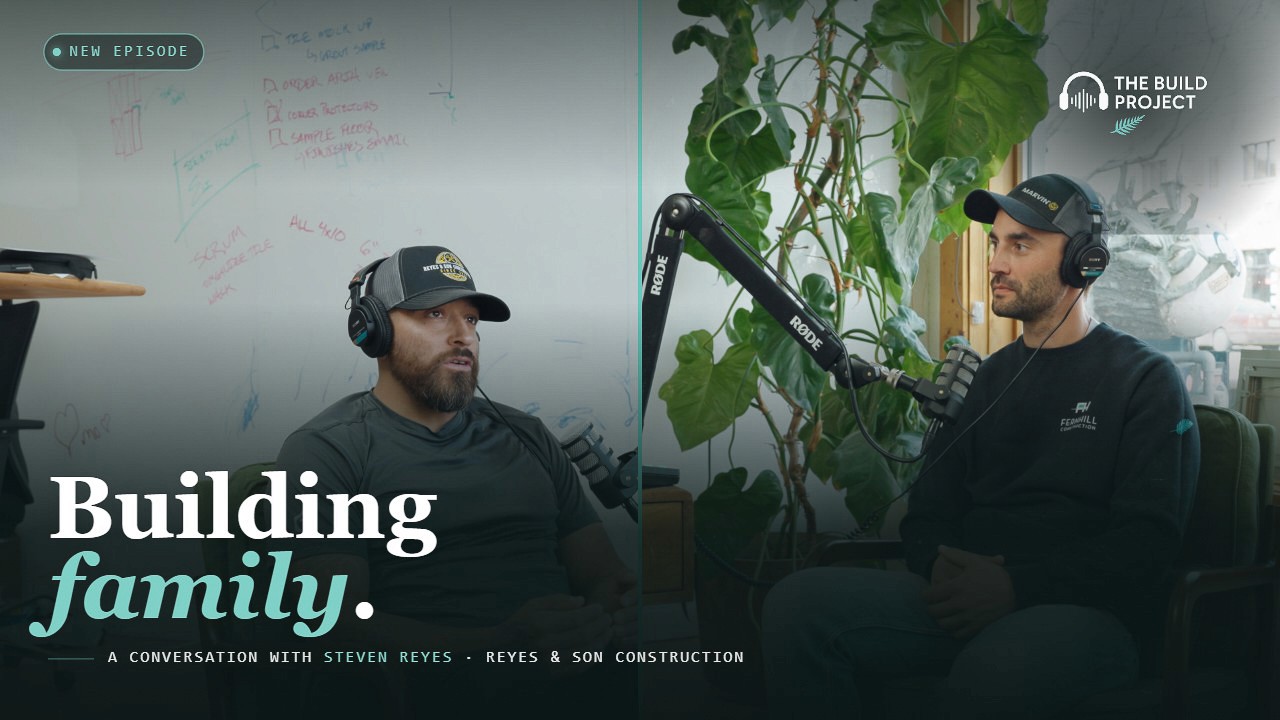
Most of the people I sit down with for The Build Project are architects. This time I sat across from a framer.
Steven Reyes runs Reyes and Son Construction, a rough-carpentry crew that has been on our last several projects. Framing, siding, decking: the work that turns a stack of drawings into something you can walk through. I wanted him on the show because a home only becomes a home through the people who build it, and the quality of that translation depends almost entirely on how early, and how honestly, everyone involved is willing to talk.
That is the part of the process I keep coming back to. A house is the result of alignment between what gets designed, what gets built, and what gets communicated between the two. Pre-construction is usually described as a conversation among the client, the architect, and the builder. But it doesn’t stop there. It runs all the way down to the person holding the nail gun. When that line of communication is clean, the homeowner feels it in the finished space. When it breaks down anywhere along the way, they feel that too, even if they never know exactly why.
Steven put the whole idea more plainly than I ever have.
How we found each other
The way Steven and I met says something about how this industry actually works. I didn’t find him through a directory or an ad. I found him through a drywaller.
My dad used to tell me that if you want to meet a good drywaller, you ask the painter. If you want a good framer, you ask the drywaller. There’s a vertical chain of trust in the trades, and the people inside it know who does the work right. Steven, for his part, built his early client list the hard way: finding builders on Google and emailing them, week after week, until someone said yes.
Reyes and Son is a family operation in the most literal sense. Steven’s father has been framing for more than thirty years and still shows up to put his head down and work. His brothers frame alongside him. When I’m on one of Steven’s sites, there’s a texture to it that’s hard to fake: people who talk to each other like family, because they are. That’s not a marketing line. It’s something you can see in how the work gets handled.
The difference early involvement makes
Steven said something I want every homeowner and every architect we work with to understand.
He told me that because of how we run pre-construction, by the time his crew is on site, they’re showing up with twenty questions instead of a hundred. Not zero questions. Twenty. The point of pre-construction was never to eliminate every unknown; that’s not how building works. The point is to be intentional about which questions are left, and to make sure there’s room to handle the ones that inevitably surface.
We saw exactly how this plays out on a recent project with a tall double-stud wall. The outer studs had to be larger members to carry a ten-foot top plate, with a staggered inner wall behind them. I had a concern: if we stood that wall without the inner framing fully integrated, I wasn’t sure the connection would hold the flatness tolerance we commit to. So we talked it through before anyone lifted anything. Steven made a call to combine methods in the field, and he told me plainly that he’d hit the flatness mark either way. My job at that point was to trust the person who actually does the work, to stop worrying and let him hit the number he said he’d hit.
He hit it.
That conversation matters far beyond one wall. The next double-stud assembly is coming up on a project in Loveland, and because we’d already worked through the first one, Steven could tell me which approach he’d recommend this time and why: a separated plate detail versus an engineered bottom plate, and what each would mean for getting that bottom member flush. That is constructability feedback I can carry back to the design team before the design hardens. If a set of prints lands on my desk that just says “build this,” there’s almost no chance I can influence how those plates get detailed. But when a trade partner tells me what it actually takes to hold the standard, I can go to the architect and the engineer and say: here’s what we need, and here’s why, and here’s how it changes the drawing.
That loop, field knowledge traveling back upstream while there’s still time to use it, is the entire argument for getting a builder involved early. Steven lives on the other end of it, and he feels the difference as clearly as I do.
“We’ll fix it”
There was a moment, early in our working relationship, that decided everything.
Something went sideways on one of the first projects, the kind of small thing that happens on every job site. Steven’s response was two words: “We’ll fix it.” No negotiation, no defensiveness, no story. Just an answer. My project lead and I talked about it afterward and landed in the same place: this is our guy.
I’ve come to believe that the measure of a company isn’t whether problems happen. Problems always happen. The measure is how you handle the moment after. Steven said it himself: if he makes a mistake, it gets fixed, because there’s no other way to operate. That instinct is rarer than it should be, and it’s the single trait I protect hardest when I find it in a trade partner.
It connects to something I think about constantly, which is that you lead with culture. If you get the culture right, you can teach almost everything else. So when we find a sub, a crew, a person who already shares that wiring, the job becomes keeping them around and growing alongside them. Steven is building his own company on the same principle from the other direction: investing in the people who stay, paying them well, and betting that the word gets around. It does. Culture is the thing that compounds.
Systems that let the standard scale
Holding a standard on one project is one thing. Holding it across several multi-million-dollar, one-off custom homes at the same time is a different problem entirely. That’s where systems come in.
We run our projects on Procore, which is not the most residentially friendly software in the world (it was built for commercial work), but it fits how we operate. Getting a new trade partner to adopt it is always a hurdle. Why would you learn a complicated platform on your first job with a builder? But Steven has come around to it, and the feature that won him over tells you something. It was RFIs and observations: the ability to photograph something on site, attach a question, and route it directly to the right person instead of letting it live in a text thread or get lost on a drive-by conversation.
On one of our active projects, we’re past five thousand photos. It sounds excessive until you need to look back at a single concealed detail months later, and it’s right there. That level of documentation is how I keep quality control honest as we grow. Without it, I’m relying on a site superintendent to remember everything and hand me a list. With it, I can sit down and see exactly how many open questions are in a given trade partner’s court, what’s quality control flowing down to them, what’s in or out of scope, and what still needs an answer. Commercial-grade systems applied to residential work: that’s not a slogan, it’s the only way I know to run intentional projects at this level without things quietly slipping.
The people behind the work
I asked Steven about the labor side, because he sits at the center of one of the hardest problems in our industry. The rough-carpentry trade has been hit about as hard as any by the labor shortage, and finding people who are both skilled and willing to stick around is a real, ongoing challenge, one nearly every framer in the Front Range is living with.
His answer was, again, about culture. The way you keep good people, especially as a smaller company, is to treat them well and pay them fairly and let the reputation travel. He told me about a guy who’d been with him five years, left for a job that promised steadier work, and called back two days later because the promise didn’t match the site. Five years of consecutive work is steady. But people sometimes have to leave to learn that.
There’s a version of this story where the small company always loses to the big one, where the good people only want benefits and stability and a logo on the truck. I don’t buy it, and neither does Steven. A small business can offer those things too, and it can offer something the big shops often can’t: being treated like a person, by someone who knows your name and your family. When you can’t offer scale, you offer respect. That’s a real strategy, not a consolation prize.
The flip side of that respect is a two-way street, and it’s one I try to hold myself to. If I go to Steven and say a detail isn’t to standard, his answer is “you’re right, let’s fix it,” no extra charge, because that’s the deal. But that means when he comes to me and says something is genuinely outside the scope of work, my answer has to be “you’re right” too. I can’t negotiate that. Each of us has an obligation to advocate for the other. Steven called it iron sharpening iron. That’s about as good a description of a healthy trade partnership as I’ve heard.
Why this matters to the people we build for
It would be easy to file all of this under “inside baseball”: framers and software and wall details that no homeowner will ever ask about. But it’s the opposite of that.
When a project has been thought through in pre-construction, the team has the bandwidth to handle the questions that come up the right way. When it hasn’t, every site becomes a series of fire drills, and the energy that should be going into the next phase gets burned answering questions that never should have been open in the first place. The client feels that difference whether or not they ever understand the cause. A calm site and a chaotic site produce two different experiences, and eventually, two different homes.
I’ve said before that luxury, in our world, isn’t excess. It’s confidence and clarity. It’s a process where the people designing, building, and communicating are actually aligned, and where that alignment reaches all the way down to the person framing the wall. A conversation with a framer might seem like a strange thing to put on a podcast that usually features architects. To me it’s the most natural thing in the world, because the home everyone is imagining at the start only becomes real through people like Steven.
You can find Steven and his crew at @reyesconstruct. The full conversation is on The Build Project, alongside Mark Schaeffer of FS Woodworks on why flush base runs three to four times applied trim.


